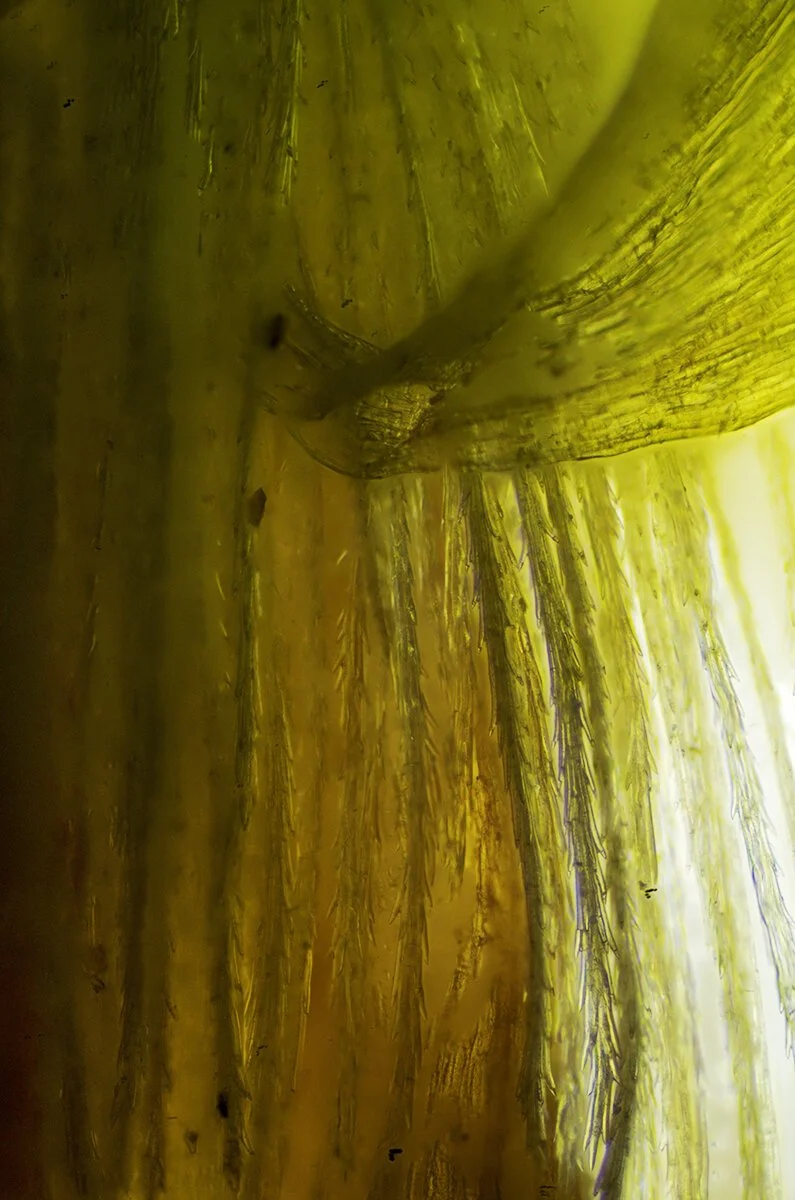
Yellow Asters Glow in Fall
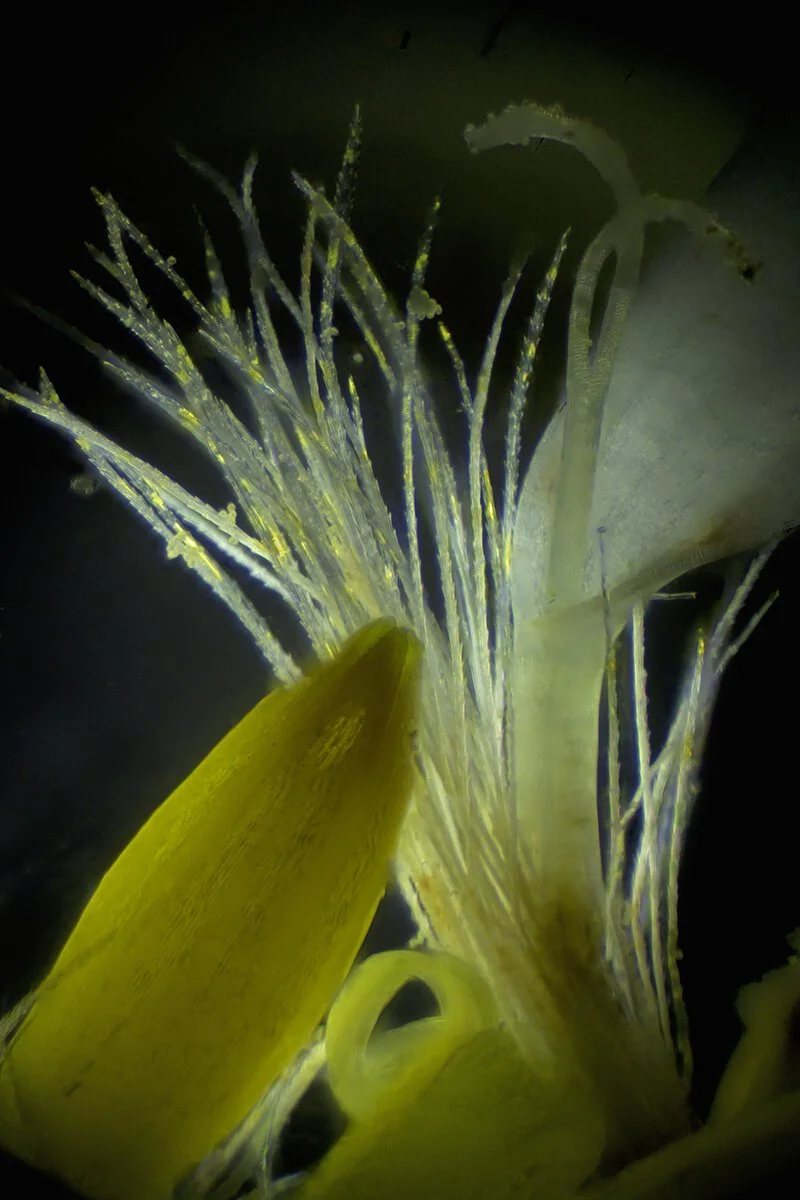
Yellow Asters with Pappus Bristles
Yellow Asters Glow in Fall
As summer fades and leaves fall, yellow asters glow. Masterful gatherers of the season’s dimming light their carotenoids absorb blue-green and violet, while reflecting back the longer yellow waves. The miracle of photosynthesis creates a joyful hue that makes me smile and attracts pollinators too. Being golden also offers protection from UVB insolation–a type of radiation that harms pollen. These asters then are blessed to be richer in plant sperm than their red or purple hued relatives, which contributes to their propagation and endurance.
Corolla tubes glisten under my microscope making the light appear to be coming from within, but I know luminance cannot exist without refraction. It is influenced by an object’s surroundings, its light sources, and the workings of my own aging eyes. The name for the aster family, Asteraceae, is derived from Greek and means star. How appropriate that stars do not just create light, but reflect each other’s luminance as well. Like asters and stars, humans also crave interactions that amplify the brightness within and that which we aspire to connect with.
How these flowers, also known as Michaelmas Asters, are able to endure for so long into the darker months is worth considering on a symbolic level. To continue being beacons of light as the sun shines fewer and fewer hours each day, they have to absorb all the darker wavelengths so only yellow is refracted. They cannot pretend melancholy hues don’t exist, like humans sometimes do, or get so involved in absorbing darkness that they forget to let themselves shine. In taking in dark waves and transmuting them, they alchemically transform themselves into attractive, glowing, ephemeral bodies. Yet their transcendence is only achieved through their physical manifestation on this planet. Though the light these plants shine can be said to come from another realm, the source wouldn’t be visible without the aster’s existence. So too we often become brighter when held in the light of a lover’s eyes. Radiance on earth is how we transcend pain and make the world better, not dreaming of leaving this earth to connect with supernatural light. So, like the asters, I do my best to keep shining and open to whatever light comes my way, whether from the sun, photosynthesizing plants, or other people whose orbits intersect mine, even though our world grows darker from those whose windows to hope and oneness have darkened.
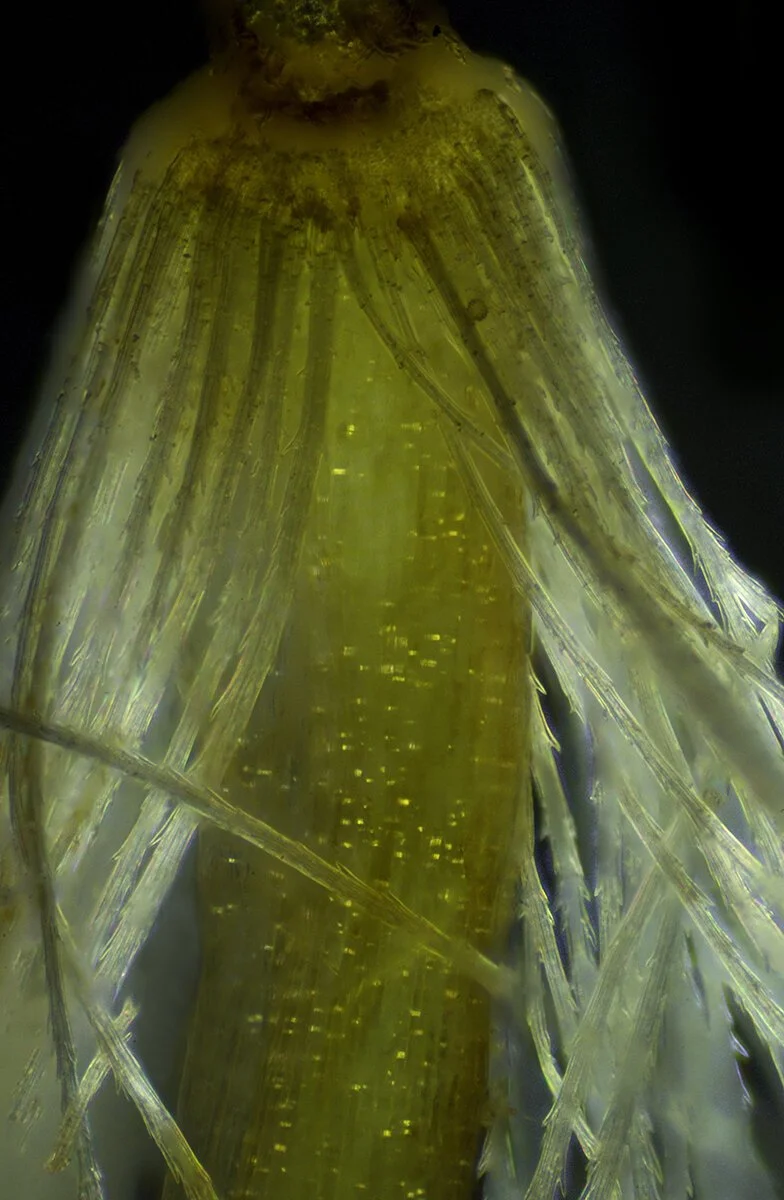
Aster Corolla Protected by Pappus Bristles
Hope is fragile and the asters must know this. Why else would they need the pappus bristle to form a protective layer around their precious petals. Pappus also form parachutes that enable the aster’s seeds to be carried by the wind. If all the seeds fell right where the aster was growing, any adverse environmental conditions would kill future offspring as well as the parent plants. For asters to survive and flourish, they have to be able to travel and not get too rooted to their immediate surroundings. As a species, humans may also be called upon to make migrations, either from the impacts of climate change or societal collapse. Nature teaches us the value in pulling up roots and relocating in stressful times..
While I study the corolla surrounded by the pappus through my scope, my heart longs to shine brighter, to celebrate love over hate, connection over dominance, joy over suffering, and empathy over selfishness. Still I am aware that there will always be darkness as well as light, threatening barbs and helping hands. The thought of letting my radiance dim is unwelcome, but until our species can find a new way of interacting I must form my own pappus bristles to shield the light I carry inside from being extinguished by all we face. Yet, if I wall myself off too much, my inner brightness will flicker, maybe even go out, and I won’t be able to connect with others who might feed my fire. So I gather a bouquet of asters and breathe in hope, as I partially peel back the layers of my armor as if lifting the edge of a curtain that veils the fullness of being and luminosity we can all claim as our own.